
Having been involved in project management for nearly thirty years, I have seen the benefits good project management can bring to any organisation. Yet I am still struck by how many organisations struggle with the basics, often pointing to a lack of time and resources—the very pressures that good project management can help ease. So how might you assess who good you are at delivery. Follow these 8 steps starting by understanding what it is you are measuring.
1. What does project management capability mean?
Project management capability means your organisation’s ability to turn an idea into a planned, completed piece of work that achieves its purpose. In simple terms: how well do you get things done when something needs to change or you need to deliver on a request from a customer?
Start by recognising the difference between projects and operations
A project has a beginning and an end and creates a specific result. Opening a new shop or introducing a booking system are projects. This follows the Project Management Institute’s explanation of a project.
Operations are the ongoing activities that keep your business running, such as serving customers, processing orders and paying staff.
| Business activity | Project: making a change | Operations: keeping it running |
| Website | Build a new website | Update prices and answer enquiries |
| Staffing | Introduce a training programme | Deliver regular staff training |
| Finance | Install an accounting system | Process invoices each week |
The two connect: once a new accounting system is introduced, using it becomes part of everyday operations. Your capability depends on whether people understand the goal, know who is responsible, have time to do the work and check progress.
Try this: Choose one upcoming change. Write its purpose, owner, intended result and target finish date on one page. The project charter template offers a starting structure.
2. Why does project management capability matter to your business?
Every project uses time, money and people that your business also needs for its daily work. When a project is unclear or poorly organised, it can pull attention away from customers, your day to day operations and create extra pressure on staff.
Imagine introducing a new booking system. If nobody agrees what it must do, who will lead the work or when staff need training, you could pay for a system that people struggle to use.
Good project management helps you make these decisions early. It gives your team a shared understanding of what needs to happen and helps you spot problems while there is still time to act.
| When this basic is missing… | Your business may experience… | A simple improvement |
| A clear purpose | Work that adds little value | Agree the business benefit |
| One person responsible | Delays and missed decisions | Name a project owner |
| A realistic plan | Disruption to everyday work | Allow time for both projects and operations |
| Regular progress checks | Problems discovered too late | Hold a short weekly review |
Try this: For one planned project, complete this sentence: “This project will help our business by ______.” Then decide how you will check whether it delivered that benefit.
A useful tool and reading: Use a simple spreadsheet to record the expected benefit and how you will measure it. The PMI introduction to projects provides further background.
3. Recognise how you manage projects today
Before making improvements, take a clear look at how work happens in your business. You do not need a formal assessment to get started. Follow these five steps.
Step 1 : Choose three recent projects. Include one that went well and one that proved difficult. Small projects count, such as moving premises or introducing a new service.
Step 2: Ask the same questions about each. Was the goal clear? Who was responsible? Was there a plan? How did you check progress? Did the finished work achieve its purpose?
Step 3: Talk to the people involved. Ask what helped them and what caused difficulties. Focus on how the work was organised.
Step 4: Record the evidence. Use this simple chart in a spreadsheet. Mark each answer “Yes”, “Partly” or “No”, and add a short example.
| Check | Project A | Project B | Project C |
| Clear goal | |||
| Named owner | |||
| Agreed plan | |||
| Progress checked | |||
| Intended result achieved |
Step 5: Look for patterns. Repeated gaps suggest where improvement could help. Repeated strengths show what you should keep doing.
Tool and reading: Excel or Google Sheets is enough for this exercise. Revisit the PMI introduction to projects if you need help choosing your examples.
You now have a practical starting picture of your project management capability.
4. Review five basics of good project management
Once you understand how your business manages projects today, review these five basics. They give you a practical foundation, whether you are introducing new software, opening a premises or improving a service.
1 Be clear about the purpose – Explain why the project is needed and what it should achieve for the business. “Introduce a booking system” describes the work. “Reduce booking errors and make appointments easier for customers” explains its purpose.
Write down what a successful result would look like. This helps everyone work towards the same goal.
2 Give someone responsibility – Name one person to lead the project and keep it moving. They should know who can approve spending, make decisions and resolve problems. Other people may carry out the work, but everyone should understand their responsibilities. In a small business, one person may fill several roles.
3 Make a realistic plan – Break the work into manageable tasks. Agree who will complete each task, when it is needed and what it will cost. Check whether some tasks must finish before others can begin. Allow for holidays, busy periods and everyday operations. A plan should reflect the time people actually have available.
4 Check progress and deal with problems – Hold a short, regular review. Ask what is complete, what happens next and what needs attention.
Record problems and decisions in one shared place. If someone requests extra work, consider its effect on time, cost and the project’s purpose before agreeing.
5 Confirm the result and learn – Before closing the project, check that the finished work meets the agreed requirements and that people are ready to use it. Agree who will look after it in everyday operations. Then review what went well and what you would change next time. Check the business benefit later if it needs time to become visible.
Useful reference: project plan explains how to record a project’s purpose, scope and responsibilities. Use these ideas to create a simple one-page brief for your next project.
5. Identify your strengths and gaps
Now use your review of recent projects to identify what your business does well and where it needs support. Work through the five basics from Part 4. For each one, ask: Do we do this consistently, sometimes or rarely? Base your answer on what happened in your projects. Add a short example to explain your assessment.
Copy this simple table into Excel or Google Sheets. The examples show how to complete it.
| Project management basic | How often? | Evidence from recent projects | What could help? |
| Clear purpose | Consistently | Goals agreed before work starts | Keep using a short project brief |
| Named responsibility | Sometimes | One project had no clear owner | Name an owner at the start |
| Realistic plan | Sometimes | Daily work delayed project tasks | Check staff availability |
| Progress checks | Rarely | Problems surfaced close to deadlines | Introduce a weekly review |
| Results and learning | Rarely | No review after completion | Schedule a closing discussion |
Look for strengths you can build on. If a short project brief already works well, make it a regular habit. Then identify gaps that recur or cause the most difficulty. A missing project owner, for example, may explain why decisions are delayed.
Try this: Highlight two strengths to keep and two gaps to address. Avoid treating this as a scorecard for individuals; assess how the business organises its work.
This spreadsheet is a starting point for discussion. In Part 6, you will choose one practical improvement to make first.
6. Choose one practical improvement
You do not need to fix every gap at once. Start with one change that addresses a recurring problem and is manageable for your team.
From problem to practical action
Imagine your review shows that project decisions often take too long. Staff are unsure who can approve changes, so work stalls.
Your first improvement could be simple: name a project owner and agree which decisions they can make. Record this in the project brief and share it with everyone involved.
Use the same approach for other gaps:
- Unclear goals? Write a short statement of purpose before work begins.
- Missed deadlines? Check people’s availability before agreeing dates.
- Late surprises? Introduce a 15-minute weekly progress review.
Make your choice
Ask three questions:
- Will this help solve a problem we experience regularly?
- Can we introduce it with the time and resources available?
- Will we be able to tell whether it helped?
Choose the improvement with the clearest benefit and a realistic chance of becoming a habit.
Try it on one project
Test the change on a current or upcoming project. Explain what people need to do and why it matters. Agree when you will review how it worked.
A shared document, calendar reminder or short checklist may be all the support you need.
Your next move: Complete this sentence: “On our next project, we will introduce ______ to help reduce ______.”
7. Build a simple action plan
Turn your chosen improvement into a small, clear plan. Everyone involved should understand what will happen, who will lead it and when you will check the result.
Your action plan at a glance
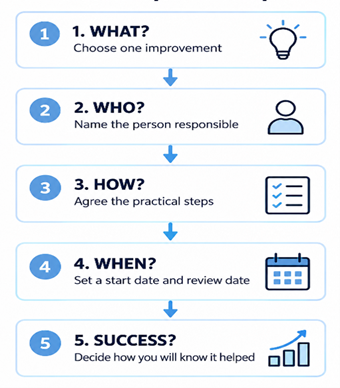
For 3. HOW? – agree the following:
- List the tasks. Write down what needs to happen.
- Put them in order. Decide what comes first and what follows.
- Assign each task. Agree who will do it.
- Check what they need. Make sure they have the time, information and tools.
- Agree a finish date. Keep it realistic.
- Check progress. Have a short catch-up to resolve problems.
Example: To introduce a weekly project review, choose a meeting time, invite the team, prepare three questions—what’s done, what’s next and what needs help—and record the agreed actions.
Success: Problems are raised earlier, and everyone knows their next action.
Check whether agreed actions are being completed. Keep the plan somewhere the team can easily find it. A shared document and a recurring calendar invitation are enough for this example. Before starting, check that the person responsible has time to carry out the change and that everyone involved understands their part.
8. Review progress and take the next step
After trying your improvement, pause and ask:
Did we do what we planned? – What difference did it make? – What worked well? – What still needs attention?
Ask the people involved for their views. Use simple evidence, such as fewer missed actions, quicker decisions or problems spotted earlier. If the change helped, make it part of your normal project routine. If it did not, adjust it and try again. Then return to your list of gaps and choose the next improvement. Building project management capability takes practice. Start small, check what works and build on it.
For a free consultation ping me an email or contact me through LinkedIn.
Leave a Reply