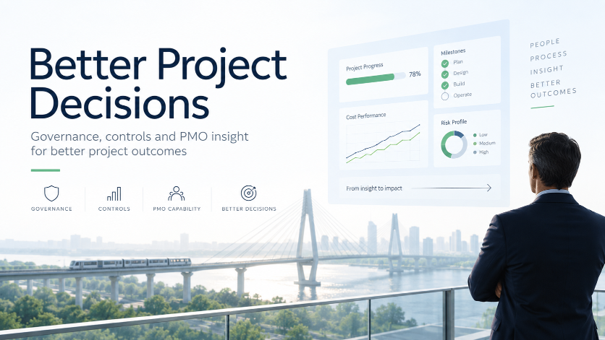
Project governance is often associated with boards, reporting structures, approval processes and meetings. All of these have a place, but they are not governance in themselves.
Good governance is fundamentally about how important project decisions are made, challenged and controlled.
For major infrastructure projects, that means being clear about who has authority, what evidence is required before decisions are taken, how risks and emerging issues are escalated, and whether the project continues to represent value for money.
The UK National Audit Office describes governance as both the formal structures and processes used to manage projects and the people and behaviours operating within them. For major projects, it stresses clarity around authority, accountability, outcomes, benefits and value—not simply cost and schedule. National Audit Office (NAO)
That distinction matters.
A project can have a steering committee, a detailed reporting pack and an extensive assurance process and still have weak governance if difficult decisions are delayed, responsibilities overlap, poor information goes unchallenged or nobody is prepared to question an increasingly unrealistic plan.
TII’s own Project Management Guidelines illustrate the opposite approach. They establish defined roles for the Sponsoring Agency and Approving Authority and require formal decisions at approval gates before projects progress. Transport Infrastructure Ireland
For me, good governance therefore comes down to a simple question:
Does the governance system help the right people make the right decisions, at the right time, using the right evidence?
The following Seven Tests of Good Project Governance provide a practical way of answering that question.
Governance is Not Project Management
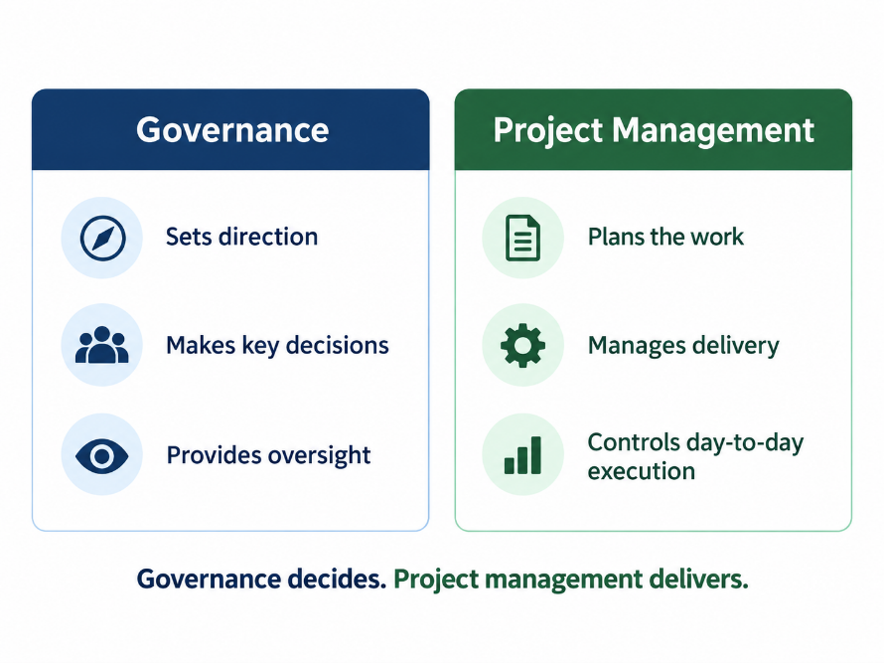
Project management and project governance are closely connected, but they are not the same thing.
Project management is concerned with delivery — planning the work, managing scope, schedule, cost, risk, resources and stakeholders to achieve the agreed objectives.
Project governance is concerned with direction and control — ensuring the project remains aligned with organisational priorities, that the right decisions are made by the right people, and that performance, risk and value are independently challenged where necessary.
A useful distinction is:
Management asks: How do we deliver this project successfully?
Governance asks: Should we continue, are we still doing the right project, and are we sufficiently confident in the evidence?
The Project Manager should not be expected to govern their own project. Governance sits above delivery and provides oversight, decision authority, assurance and escalation.
For major infrastructure projects, the strongest arrangements connect the two: project controls provide reliable information, the PMO helps turn that information into insight, and governance bodies use it to make timely decisions.
A simple way to visualise the relationship is:
Governance sets direction and makes major decisions → Project management delivers within those boundaries → Controls and PMO provide the evidence connecting both.
The Seven Tests of Good Project Governance
Good governance should be visible in the way a project operates. It should influence how priorities are set, how information is presented, how decisions are made and how emerging problems are dealt with. The UK Project Routemap identifies four core governance pillars: accountability, empowered decision-making, strategic alignment, and effective reporting and assurance. GOV.UK
Building on those principles, I use seven practical tests.
1. Purpose — Are we still clear about why the project exists?
Governance starts with purpose. The project should have a clear connection to the organisation’s strategy, intended outcomes and benefits.
This sounds obvious, but major projects can gradually become focused on delivering the asset rather than delivering the outcome. Scope grows, circumstances change and assumptions made years earlier can become embedded.
A good governance board should therefore keep asking: Does this project still solve the right problem, and does the current solution still represent the best way of solving it?
The NAO makes an important distinction here: major-project governance must consider outcomes, benefits and value as well as cost. National Audit Office (NAO)
2. Accountability — Is it clear who owns the outcome?
Everyone attending a governance meeting is not the same as everyone being accountable.
There should be clear ownership of the investment decision, business case, benefits, delivery and major risks. On complex infrastructure programmes involving sponsors, delivery bodies, consultants, contractors and government departments, blurred accountability can become a significant risk.
A useful test is simple: when an important issue emerges, can we immediately identify the person accountable for resolving it?
If the answer is a committee, governance may already be too diffuse.
3. Decision Rights — Is it clear who can decide what?
Projects slow down when decisions continually move upwards because authority has not been delegated clearly. They also become exposed when important decisions are made at the wrong level.
Good governance establishes explicit decision rights, delegated authorities and tolerances.
Project teams should know what they can decide themselves, what must go to the project board and what requires sponsor or approving-authority intervention.
The Project Routemap specifically recommends sufficient autonomy for decisions to be made at the lowest appropriate level while maintaining clear accountability. GOV.UK
4. Evidence — Are decisions based on reliable information?
A governance structure is only as good as the information flowing through it.
Decision-makers need an integrated view of scope, cost, schedule, risk, benefits, interfaces and assumptions. Reporting that concentrates primarily on whether milestones are red, amber or green can create the appearance of control without providing real insight.
This is also where benchmarking, reference class forecasting, trend analysis and lessons from comparable projects can strengthen the decision process.
The question should not simply be “What is the project team forecasting?”
It should also be “What evidence gives us confidence that this forecast is realistic?”
What Good Governance Looks Like in Practice
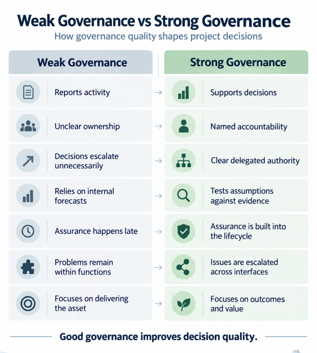
Good governance becomes visible in the way a project behaves, particularly when something starts to go wrong.
On a well-governed project, the sponsor is clear about the outcomes being sought, decision rights are understood, and the project team knows when it can act independently and when an issue must be escalated. Cost, schedule, scope, risk and benefits are not reviewed in isolation; they are brought together to support decisions.
That means governance meetings should not become lengthy reporting sessions. The emphasis should be on exceptions, emerging risks, decisions required and whether the project remains on a credible path.
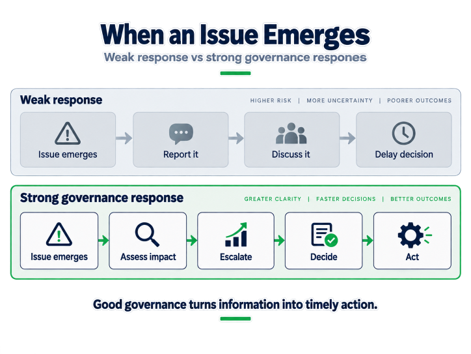
For example, if a major infrastructure project is forecasting a six-month delay, good governance does not simply record the revised completion date. It asks what is driving the delay, what interfaces are affected, whether costs and benefits have changed, what recovery options exist, and whether additional decisions are now required.
Similarly, if costs are increasing, governance should challenge more than the latest estimate. It should examine the assumptions behind it, compare performance against relevant benchmarks, test contingency levels and understand whether the business case remains sound.
Good governance also means that difficult information travels quickly. A project manager should not feel pressure to keep an issue within the team until a solution is found. Early escalation should be seen as a sign of control, not failure.
In practice, strong governance creates three things:
clarity about who decides, confidence in the evidence, and timely action when performance moves outside tolerance.
Lessons from Major Infrastructure Projects
Major infrastructure projects offer useful evidence of what good—and weak—governance looks like in practice.
Luas Cross City: governance that supported delivery
Luas Cross City required coordination across TII, the NTA, Dublin City Council, contractors, transport operators, businesses and numerous other stakeholders. Delivering a major light-rail project through a functioning city required more than good scheduling—it required clear responsibilities, strong interface management, coordinated decision-making and active stakeholder governance.
Importantly, lessons from Luas Cross City are now being carried into schemes such as Luas Finglas and MetroLink, demonstrating the value of capturing organisational learning rather than starting each major project from scratch. Internet Archaeology
Lesson: Good governance creates the structure within which complex interfaces can be managed and timely decisions made. Just as importantly, mature organisations deliberately transfer governance and delivery lessons from one major project to the next.
National Children’s Hospital: when governance and controls are not strong enough early
The National Children’s Hospital provides a useful Irish counterpoint.
The 2019 PwC review found weaknesses in project set-up, planning, budgeting, execution and governance. It recommended a major strengthening of the project-control environment, a formal assurance strategy, stronger commercial capability and more effective scrutiny across the governance structure. Gov.ie
The important lesson is not simply that costs increased. It is that governance and control arrangements were not sufficiently mature for a project of this scale and complexity at the point when critical decisions were being made.
Contrast that with stronger governance:
Poor governance
- Weak challenge of early assumptions
- Inadequate cost and control maturity
- Accountability spread across multiple bodies
- Assurance strengthened only after problems emerged
- Decisions increasingly constrained by commitments already made
Good governance
- Independent challenge before major commitments
- Integrated cost, schedule and risk controls
- Clear authority and accountability
- Assurance built into each decision gate
- Real options to pause, redesign or reconsider before lock-in
The PwC review ultimately prompted wider changes to how major Irish capital projects are governed, including stronger lifecycle controls and central challenge of major investments. Oireachtas Data
Lesson: the best time to strengthen governance is before the project becomes difficult to change. Once contractual, political and financial commitments harden, governance can still improve delivery—but it has far less room to change the outcome.
A Practical Governance Health Check
A useful way to test governance is to ask a small number of direct questions. If the answers are unclear, inconsistent or dependent on individual personalities, the governance system probably needs attention.
Eight questions for a project sponsor, board or PMO:
- Purpose: Is the project still solving the right problem and delivering the intended value?
- Accountability: Is it clear who owns the business case, benefits, delivery and major risks?
- Decision rights: Are authorities, tolerances and escalation routes understood?
- Evidence: Are decisions supported by reliable cost, schedule, risk, scope and benefits information?
- Forecasting: Are assumptions tested against external benchmarks and comparable projects?
- Control: Do we know early when performance is moving outside agreed tolerances?
- Challenge: Is there genuine independent assurance and constructive challenge?
- Action: When issues arise, are decisions made quickly enough to influence the outcome?
The purpose of the health check is not to create another compliance exercise. It is to identify where governance may be slowing decisions, hiding risk or giving senior leaders false confidence.
The PMO can play an important role here by bringing together controls, risk, assurance and decision information into a coherent view for leadership.
Closing: Governance Should Enable Better Decisions
Good project governance is not about adding more committees, reports or approval layers.
It is about creating the conditions for better decisions.
That means clear accountability, reliable evidence, defined decision rights, effective controls, independent challenge and timely escalation.
For complex engineering and infrastructure projects, this becomes even more important because decisions made early can commit organisations to years of expenditure and constrain future options.
The strongest governance systems therefore do two things well:
They give delivery teams enough authority to get on with the job and give sponsors enough visibility and confidence to intervene when necessary.
That is the balance good governance should achieve. Good governance does not slow projects down. Poor decisions do.
How confident are you that your project governance turns data into timely decisions?
Author Brian Cleere helps organisations make better project decisions
Leave a Reply