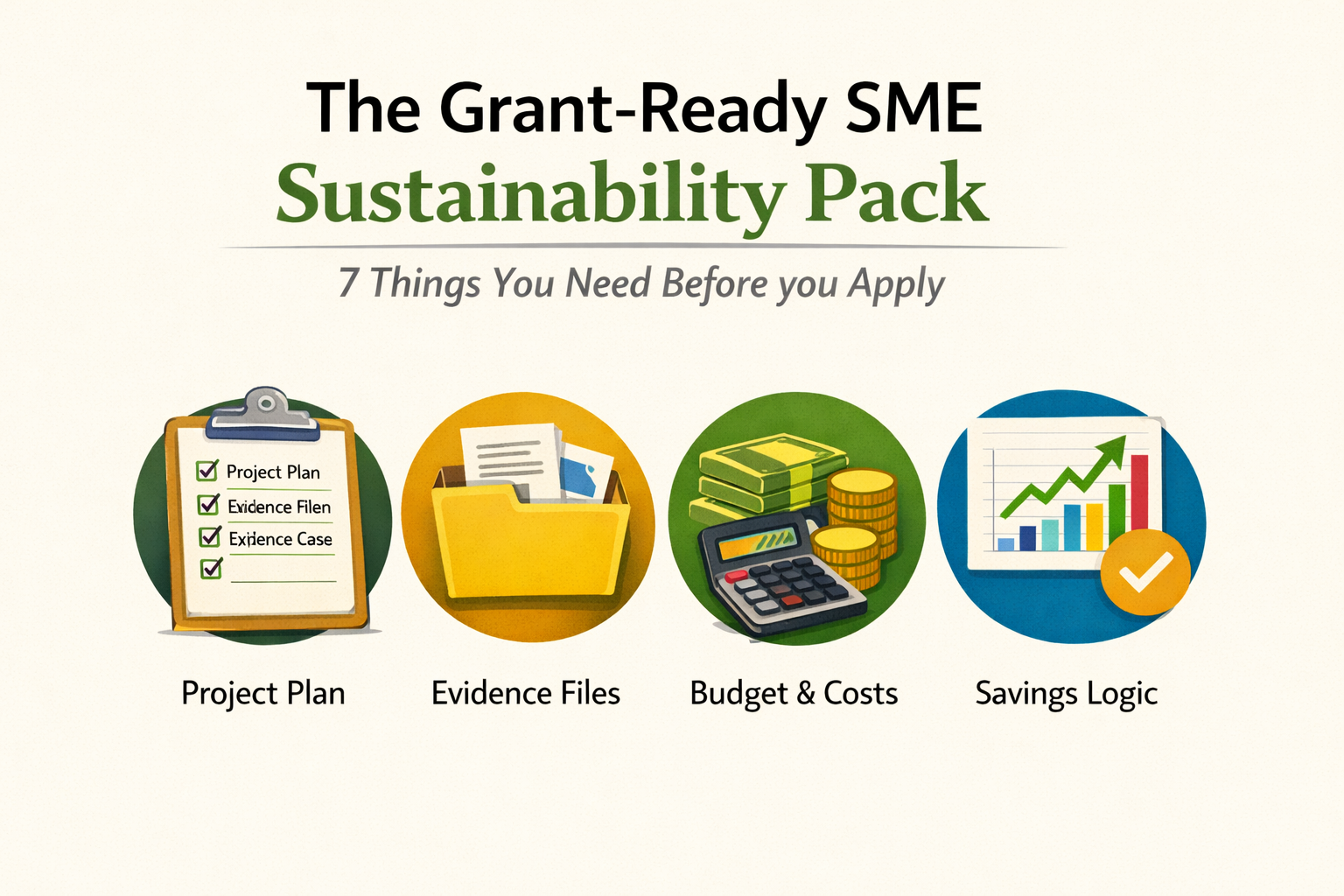
The 7 things you need before you apply for anything
Most SME owners don’t struggle with motivation—they struggle with time, clarity, and confidence. You know you should reduce energy and waste costs, you may have customers asking questions, and you’ve probably heard there are grants “out there”… but the whole process can feel vague and admin-heavy.
The truth is, applications usually don’t fail because the idea is bad. They fail because the project isn’t clearly defined, the evidence is scattered, the costs aren’t firm, and the expected savings are hard to explain. That’s frustrating, because the fix is simple: before you apply for anything, build a short, practical Grant-Ready Sustainability Pack. It’s not a big report. It’s a tidy set of documents and numbers that makes your project easy to assess, easy to approve, and easy to deliver once funding comes through.
Use the checklist below to create your pack in a day or two and you’ll immediately be in a stronger position for grants, bank conversations, and customer enquiries.
1) A one-sentence project goal
What it is: A plain-English statement of what you’re doing and why.
Why it matters: If you can’t describe it simply, the application becomes messy.
Example: Reduce electricity use in our cold-room and kitchen by 15% within 6 months through controls and equipment upgrades.
2) A quick baseline snapshot
What it is: Your starting point using what you already have: recent bills, fuel spend, waste invoices, mileage, etc.
Why it matters: Grants and management teams want proof you’re solving a real problem and you’ll need this to show results later.
Tip: Don’t aim for perfect. Aim for credible and consistent.
Helpful starting point: Climate Toolkit 4 Business (free baseline + actions).
https://climatetoolkit4business.gov.ie/
3) A focused scope and boundaries
What it is: What’s included, what’s excluded, and what “done” looks like.
Why it matters: It prevents scope creep and helps suppliers quote properly.
Include: location/site, assets affected, operating hours assumptions, exclusions (e.g., no building fabric works in this phase).
4) Evidence folder (simple but complete)
What it is: A single folder with the essentials: bills, photos, equipment list, maintenance logs, waste invoices, current controls, etc.
Why it matters: Most delays happen because evidence is scattered across inboxes and phones.
Tip: Name files clearly (e.g., Electricity_Bill_Jan2026.pdf – ColdRoom_Nameplate.jpg).
5) Budget, quotes, and an “all-in cost”
What it is: Your cost estimate including supply, install, enabling works, downtime, commissioning, training.
Why it matters: Grants fund eligible costs, so you need clarity on what you’re actually buying and why.
Tip: Get at least one quote early, even if it’s indicative. It sharpens scope fast.
6) Simple savings + payback logic
What it is: A back-of-the-envelope calculation anyone can follow.
Why it matters: Funders love projects that clearly reduce costs and emissions.
Tip: Use conservative assumptions (lower-bound savings). If it still stacks up, it’s a safer project.
If you need a structured diagnosis first, SEAI’s audit support is a good route:
https://www.seai.ie/grants/business-grants/energy-audits
And overview of SEAI business supports:
https://www.seai.ie/grants/business-grants/
7) Delivery plan + responsibilities (90 days)
What it is: A short implementation plan: who does what, by when, and how you’ll measure before/after.
Why it matters: A grant-ready project is also a delivery-ready project.
Include: project owner, supplier contact, milestone dates, measurement method, and a monthly check-in.
How I can help (the fast way to get this done)
If you want to move quickly, I help SMEs build this Grant-Ready Pack in a practical, lightweight way—typically over 2–3 sessions. We’ll:
- choose the right first project (using a simple scoring method)
- tighten the scope and evidence folder
- produce the mini business case (savings/payback + KPIs)
- match the project to the most suitable support pathway
- set up a 90-day delivery plan so it doesn’t stall after approval
Result: you’re not just “applying for something”, you’re ready to fund, deliver, and prove your first sustainability win, improve your brand and realise efficiencies in your operations. All of which help with the bottom line.
Leave a Reply