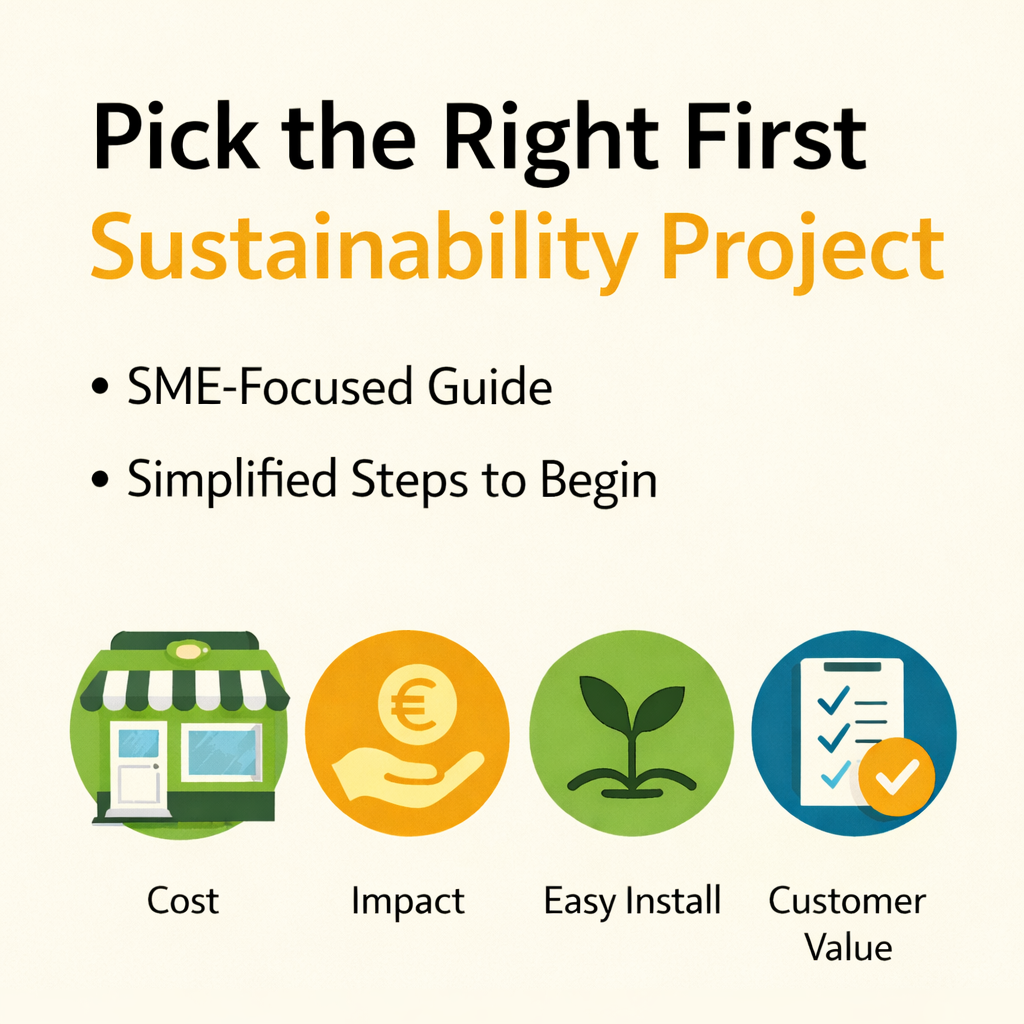
Choose the right first sustainability project (a simple scoring method for SMEs)
Running a business is busy. You’re juggling customers, staff, suppliers, cashflow and then you hear “sustainability” and it can feel like a massive extra job. The good news is you don’t need a big programme to start. Some SMEs fail at sustainability because they try to boil the ocean. If you pick a project that is too complex, you’ll lose interest or run out of budget. If you pick one that is too small, nobody notices and little benefit accrues. You just need one first project that’s practical, delivers a real benefit, and is easy to prove. By focusing on a quick win, you build the internal momentum and confidence needed to tackle bigger projects down the road without compromising your day-to-day operations.
Your first project should ideally do three things:
- Save money (or reduce waste) quickly
- Avoid disruption to day-to-day operations
- Show clear results you can point to with confidence
This post gives you a simple method to shortlist ideas and choose the best first move—without overthinking it.
Step 1: Start with a quick baseline
Before you pick a project, get a quick read on where your money is going. You don’t need perfection just enough clarity to avoid wasting effort.
Two simple starting points:
- Climate Toolkit 4 Business – a free calculator and action-plan approach that helps you estimate your footprint and identify improvement areas.
https://climatetoolkit4business.gov.ie/ - SEAI Energy Audit (voucher support) – an independent, structured way to identify your best opportunities and typical savings.
https://www.seai.ie/grants/business-grants/energy-audits
If you’re a micro enterprise, your Local Enterprise Office can also be a strong starting point through Green for Business supports:
https://www.localenterprise.ie/green/
Step 2: Build a shortlist (keep it to 3–6 options)
Don’t try to fix everything. Choose a shortlist that reflects your biggest pain points, for example:
- Energy bills (electricity, heat, process loads)
- Waste costs and inefficiency in processes
- Fleet fuel and travel costs
- Old equipment that’s expensive to run
- Customer/tender pressure (needing proof of action)
Your shortlist might include: lighting upgrades, heating controls, insulation, equipment optimisation, refrigeration efficiency, compressed air fixes, solar PV, heat recovery, process improvements, waste reduction initiatives, or fleet changes.
Step 3: Score each option using the “8-factor test”
Here’s the method: score each project from 1 to 5 (5 is best). Add the scores. The highest score is usually your best “first project”.
The 8 factors (SME-friendly)
- Payback – how quickly it saves real cash
- Upfront cost – lower cost = higher score
- Disruption – less downtime/headache = higher score
- Impact – does it materially improve energy/waste/emissions
- Ease of delivery – do you have capability and suppliers
- Ease of measurement – can you prove before/after
- Grant fit – is there a clear support route
- Customer value – does it help with tenders/supply chain questions
Rule of thumb: for your first project, aim for high scores in payback + low disruption + easy measurement. Bigger or more complex projects can come next.
Step 4: Choose the best first project (not the greenest idea)
A common trap is choosing the project that sounds the most impressive. The best first project is the one you’ll actually complete and then proudly talk about.
A strong first project typically:
- Delivers savings within months (not years)
- Is straightforward to implement
- Can be measured with simple evidence (bills, meter reads, invoices)
- Creates a repeatable approach you can apply again
Think of it as building momentum. One good win unlocks the second.
Step 5: Match the chosen project to the right support
Once you’ve selected the top project (or top two), you can match it to available supports. Common pathways include:
- LEO Energy Efficiency Grant (often a next step after a report/audit)
https://www.localenterprise.ie/portal/energy/what-is-the-energy-efficiency-grant-/what-is-the-energy-efficiency-grant-.html - Enterprise Ireland Climate Action Voucher (to help get a plan and expert support in place)
https://www.enterprise-ireland.com/en/supports/climate-action-voucher - SEAI business supports (audit and upgrade routes)
https://www.seai.ie/grants/business-grants
The best sequence is simple:
baseline → shortlist → score → choose → fund → deliver → measure
A quick example (how it works in real life)
Let’s say your shortlist is:
- LED lighting upgrade
- Heating controls optimisation
- Solar PV
- Waste segregation and reduced collections
When you score them, you might find:
- LED lighting: high payback, low disruption, easy to measure
- Heating controls: very low disruption, strong savings, easy to prove
- Solar PV: bigger spend and lead time (still good, just not always first)
- Waste reduction: strong savings but needs behaviour/process changes
Result: you pick controls or lighting as the first project, get the win, then move to PV and deeper process improvements next.
How I can help
This is exactly what my Service Line 1 (Getting Started / Green Funding & Enablement) is designed for.
I help you:
- shortlist and score the best options
- define the project properly (scope, timeline, roles, savings estimate)
- match it to the most suitable support route
- build a simple evidence pack so the application and delivery run smoothly
Instead of guessing, you end up with a clear decision: what to do first, why it’s the right move, and how to fund and deliver it.
Useful links (all in one place)
Climate Toolkit 4 Business – https://climatetoolkit4business.gov.ie/
LEO Green supports – https://www.localenterprise.ie/green/
LEO Energy Efficiency Grant – https://www.localenterprise.ie/portal/energy/what-is-the-energy-efficiency-grant-/what-is-the-energy-efficiency-grant-.html
SEAI Energy Audits (voucher) – https://www.seai.ie/grants/business-grants/energy-audits
SEAI Business Grants overview – https://www.seai.ie/grants/business-grants/
Enterprise Ireland Climate Action Voucher – https://www.enterprise-ireland.com/en/supports/climate-action-voucher
Leave a Reply